
#Chapter 8: Dreams and Altered States of Consciousness — The E-I-B-A Unified Spectrum
A note on the numerical values: The numbers appearing in this chapter (and throughout the book) — for example "0.6–0.8 Rice", "B-network information entropy > 0.9" — are all illustrative reference values, intended to give an intuitive comparison of the relative levels of different conscious states. They are not measured data, and do not represent precisely quantifiable physical quantities. The reader should understand them as a quantified sketch of "low / medium / high", rather than as empirical measurement results.
On the unit "Rice": In this theory, the unit of consciousness intensity is the "White-Cabbage-Rice" system — "White" (W) is the standardized unit of differentiation (D), "Cabbage" (C) is the standardized unit of integration (I), and "Rice" (R) is their product, the final consciousness intensity (\bigstar = D \times I). 1 Rice is the level of consciousness of a standard human waking resting state.
#8.0 Introduction: The Riddle of the Continuity of Conscious States
Standing in a twenty-first-century neuroscience laboratory, we hold a precise catalogue of conscious states: wakefulness, the various stages of non-REM sleep, REM sleep, anesthesia, epileptic seizure, coma…… Each state carries its corresponding EEG signature, metabolic pattern, and behavioral marker. Yet when we turn to the first-person world of experience, this catalogue suddenly seems pale and powerless. Why is it that logically rigorous waking thought, the dazzling absurdity of ordinary dreams, the self-aware clarity of lucid dreams, the "pure awareness" of deep meditation, and the "panoramic life review" of near-death experiences — experiences whose subjective textures differ so radically — are all nonetheless called "consciousness"?
Traditional consciousness science is trapped in an awkward split: on the one hand, it excels at measuring the physiological correlates of states; on the other, it is mute about the experiential essence of those states. We divide sleep into NREM and REM, but the classification itself never answers: where does the continuity lie, from deep dreamless slumber, to fragmented light dreams, to long narrative dreams?
Chapter 5 has already given us the mathematical language to answer this question — information entropy, transfer entropy, synergistic information, and the phase synchronization order parameter. Chapter 6 anchored these variables to concrete neural structures. This chapter will deploy this E-I-B-A information-dynamics framework to draw an unprecedented "complete map of the universe of consciousness." On this map, all known altered states of consciousness will be revealed as emergent patterns of one and the same dynamical system across different parameter regimes. We will see that from wakefulness to deep sleep, from logic to absurdity, from self-mastery to mystical transcendence, everything is nothing but the eternal variation played — at different intensity ratios and coupling patterns — by the information entropy of the four basic dimensions E (exteroceptive perception), I (introspective integration), B (bodily feeling), and A (active regulation), together with the transfer entropies among them (such as , , ), upon the unified stage of the electromagnetic field.
Now, let us begin this journey across the boundary of consciousness.
#8.1 Dynamical Reconstruction of the Sleep Cycle: From Wakefulness to Dreamless Deep Sleep
#8.1.1 An E-I-B-A Reading of the Traditional Sleep Stages
Sleep is not the "shutting off" of consciousness; it is a deep and regular exploration of state space by the conscious dynamical system. According to the American Academy of Sleep Medicine's standard, an adult's nightly sleep consists of 4–6 cycles, each about 90 minutes, passing in turn through N1, N2, N3 (collectively non-REM sleep, NREM) and REM (rapid eye movement sleep). From the perspective of the E-I-B-A model, this is not a passive "shutdown sequence", but an active, structured journey of information-dynamical phase transitions.
The waking state (W) is the baseline of the conscious system. Here, the A-network maintains high-intensity regulatory output (high ), and explores the E-I-B cube rapidly and flexibly. The information entropy of both the E-network and the I-network sits at medium-to-high levels, held in dynamic balance, switching between external perception and internal thought as needed. Crucially, (the I→E transfer entropy — the drive of endogenous imagination upon perception) is effectively suppressed by the A-network, preventing daydreams from contaminating real-world perception. The global electromagnetic field sits at the edge of chaos; the EEG shows desynchronized, low-amplitude fast waves (, ) and a stable rhythm. Here the degree of consciousness is at its baseline level (about 1.0 Rice).
The N1 stage (sleep onset) marks the beginning of the first phase transition. In information-dynamical terms, this shows up as the loosening of the A-network's active regulatory capacity — its output normalized transfer entropy () declines across the board. In state space, begins to contract toward the origin:
The E-network's information entropy gradually decays: the richness and unpredictability of environmental sounds, light, and other sensory signals decline, and perception becomes blurred. The corresponding falls.
The I-network shifts from order to free drift: from linear, logical trains of thought (medium entropy, structured) to fragmentary, non-logical associations (entropy may briefly rise, but integration falls). This is the information-dynamical basis of "hypnagogic imagery" — the I-network, after the weakening of A-network suppression, spontaneously produces high-entropy but low-integration fragments of thought. Notably, at this moment (the transfer entropy) may briefly emerge, driving the sensory cortex to produce tiny dream fragments.
The B-network's information entropy turns inward: the body gradually relaxes, muscle tone drops, and interoceptive signals (fatigue, comfort) shift from background noise to salient signals, though their pattern becomes monotonous (entropy may fall from a medium-high level to medium).
The A-network's regulatory entropy declines: the A-network loses its ability to select and organize content; its output transfer entropies (, ) fall from high to medium-low.
At this moment, begins to decline slowly, to about 0.6–0.8 Rice. This is experientially that state of "drowsiness" and "drifting thoughts".
The N2 stage (light sleep) is an important reorganization of conscious information dynamics. The A-network's regulatory output falls further to a very low level, and the system is driven more by the intrinsic coupling and self-organization of the E, I, and B networks. is attracted toward the B axis:
The E-network's information entropy nearly shuts off (): the external world retreats from consciousness, and the activity pattern of the sensory cortex becomes monotonous and low-entropy.
The I-network's information entropy drops sharply and becomes highly fragmented: it may appear only as brief memory processing corresponding to "sleep spindles", or as isolated dream fragments. Here the I-network's activity persists, but cannot sustain a coherent narrative structure.
(the transfer entropy) approaches zero: endogenous imagination can no longer systematically drive the sensory cortex to produce perceptual experience, because the I-network itself lacks sufficient structured information.
The B-network's information entropy becomes dominant: bodily repair, immunity, and metabolism proceed in depth, and the interoceptive system maintains the basic tone of life. Here the B-network's activity is slow but sustained and ordered (medium-to-low entropy, corresponding to steady physiological rhythms).
The A-network's regulatory output essentially shuts off: it loses its ability to select and organize content. Each component of approaches zero.
At this point the degree of consciousness falls significantly, to 0.3–0.5 Rice. The differentiation is low (impoverished content), and the integration is also low (content lacks coherent organization). If wakefulness is a symphony of high information entropy and high integration, then N2 leaves only a few scattered instruments occasionally sounding in the background.
The N3 stage (deep sleep, slow-wave sleep) is the lowest baseline of conscious experience. contracts to very near the origin:
The E-network's information entropy approaches zero: complete absence of external perception.
The I-network's information entropy approaches zero: no narrative, thought, or dream experience. Upon later awakening, subjects typically report "nothing at all" or "a blank".
approaches zero.
The B-network's information entropy drops to its lowest but non-zero level: the body maintains basic life rhythms (heartbeat, breathing, metabolism), but the complexity of these signals is extremely low — they are highly regular periodic oscillations, corresponding to extremely low spectral entropy. This is precisely the "B-field substrate" that Chapter 22 will elaborate.
The A-network's regulatory output falls to zero: regulation stops entirely.
Here the degree of consciousness approaches zero. The global electromagnetic field undergoes a phase transition from the edge of chaos to a highly ordered, globally synchronized state; the EEG shows high-amplitude, low-frequency waves (0.5–4 Hz). This is an information-dynamical "freezing" — the system is trapped in an extremely stable, low-dimensional attractor, losing the capacity to produce high-entropy, high-complexity experience. Yet this is not death, but the "seed state" of consciousness, reserving the necessary physiological restoration and chemical reset for the REM dreams that follow.
The REM stage (rapid eye movement sleep) is the most distinctive stage of the sleep cycle. The A-network's regulatory output remains at an extremely low level (prefrontal executive function shuts off), but the I-network's information entropy soars, and (the transfer entropy) and (the transfer entropy) become dominant — this is the information-dynamical core of dreaming. The source of perception switches from the external (E) to the internal (); the narrative engine (I) not only drives the plot, but simultaneously drives perceptual content (through the transfer entropy) and emotional-bodily reactions (through the transfer entropy). This is a new, self-consistent mode of information processing that the conscious system enters after a fundamental change in its input and regulatory conditions.
#8.2 The Nature of REM Dreaming: The and Coupling of Virtual Reality
#8.2.1 An E-I-B-A Redefinition of Dreaming
Dreams, especially vivid REM dreams, have long been regarded as the "freaks" of the consciousness puzzle: they possess perceptual vividness, narrative coherence, and emotional intensity, yet lack the two hallmarks of waking consciousness — an accurate representation of external reality and logically consistent metacognitive monitoring.
The E-I-B-A model offers an explanation that strikes at the core: the dream is not a degeneration or confusion of consciousness, but a new, self-consistent mode of information processing that the conscious system enters after a fundamental change in its input and regulatory conditions. The key lies in two points:
1. The switch in the source of perception: from E (external perception) to (endogenous perception)
In dreams we do not lack "perception". On the contrary, we "see" splendid scenes, "hear" voices of conversation, "feel" ourselves running or flying. The sensory texture of these experiences is so real that we believe them while dreaming. The root lies in the fact that the driving source of perception switches from the external physical world to the brain's internal memory and simulation systems.
We must precisely distinguish two modes of perception:
External perception (E): driven by the external physical world; the E-network's information entropy is high; its physical pathway is "world sensory organs thalamus sensory cortex".
Internal perception (endogenous perception driven by the I-network): its information-dynamical essence is high (the transfer entropy); its physical pathway is the descending projection from "the I-network (hippocampus, medial prefrontal cortex, etc.) the sensory cortex". The information entropy of endogenous perception does not come from the complexity of the external world, but from the I-network's ability to recombine memory fragments into novel patterns.
In REM dreams, the E-network's information entropy is extremely low (), because the sensory gate is closed and external signals cannot enter; but (the transfer entropy) is medium-to-high (), and the I-network's narrative engine is massively driving the sensory cortex through transfer entropy to generate endogenous perceptual scenes. The hippocampus shows intense, wake-like activity during REM, thought to replay or reorganize daytime memories and project them back to the sensory cortex. Thus the perception in dreams is not a new independent network, but the subjective manifestation, at the level of consciousness, of this directed transfer entropy .
2. The switch in regulatory mode: the functional shutdown and backgrounding of the A-network
During wakefulness, the A-network (the prefrontal executive control network) acts like a strict director, reviewing the reality of perceptual content in real time, organizing the logic of thought, and regulating the appropriateness of emotion. One of its key functions is to suppress (the transfer entropy), preventing endogenous imagery from contaminating real-world perception.
In REM dreams, this director almost leaves the stage. Neuroimaging shows that during REM sleep, the metabolism and blood flow of the dorsolateral prefrontal cortex (the core of the A-network) drop significantly, approaching deep-sleep levels. This leads to:
Disinhibition of (the transfer entropy): endogenous imagery flows freely, constituting the perceptual scenes of the dream.
Failure of reality monitoring: we do not question the absurdity of flying or passing through walls in dreams, because the A-network responsible for reality-testing is offline.
Loose narrative logic: dream plots can jump, merge, and be incoherent, because there is no "director" to maintain narrative coherence — this corresponds to a drop in the internal integration of the I-network.
Disinhibition: desires, fears, and memory fragments suppressed by waking social norms or self-censorship are allowed to surface — such content maintains a low-entropy state while suppressed, and its information entropy can be fully expressed once the suppression is lifted.
Notably, the A-network is not entirely shut off. Parts related to emotion and motivation, such as the anterior cingulate cortex, remain active, which explains why dreams still possess basic goal-direction (fleeing, seeking) and emotional coherence. This "partially shut off" state is the root of the dream being simultaneously absurd and internally somewhat consistent.
The information-dynamical definition of dreaming:
Dreaming is a state of consciousness in which, when the A-network's regulatory output () is extremely low (prefrontal executive function shut off), the system enters a mode dominated by the high information entropy of the I-network, with the transfer entropy and the transfer entropy becoming the primary content-generation mechanisms. The driving source of perception switches from the external (E) to the internal (); narrative, perception, and emotion form a closed self-exciting loop.
#8.2.2 The Cube Coordinates of the Ordinary Dream and Its Signature
Based on the above analysis, we can precisely locate a typical ordinary REM dream in information-dynamical terms:
Cube position: sits high in the I-B plane, but unlike wakefulness, the E-network's information entropy is extremely low (≈ 0.1–0.2); in its place, the transfer entropy is medium-high (0.6–0.8). The I-network's information entropy is high (0.7–0.9), the B-network's is medium-high (0.4–0.7), and the A-network's regulatory output is extremely low (0.1–0.3).
Differentiation : medium-high. Dream content can be extremely rich, with profuse detail and diverse emotion. This is because high transfer entropy can mobilize large numbers of memory fragments for recombination, producing strange combinations rarely seen in waking life.
Integration : medium-to-low. This is the key difference between dreaming and wakefulness. Because the A-network's regulatory output is absent, logical constraints and reality-calibration are missing:
Second-order integration (the transfer-entropy level) is passable: there are basic associations among dream elements (characters bound to scenes).
Third-order integration (synergistic information) is weak: plot twists are abrupt, spatiotemporal relations are jumbled, and the stability of E-I-B triadic synergistic information declines.
Fourth-order integration (global phase synchronization ) is special: dreaming usually carries a strong "sense of presence" and a "dream self", but this self lacks reflective metacognition — this corresponds to a kind of "immersive unity" ( held at a medium level, but lacking active A-network monitoring), different from the "reflective unity" of wakefulness.
Degree of consciousness : about 0.4–0.6 Rice. Lower than the waking baseline, but markedly higher than deep sleep. This explains why dreams feel "real" upon waking, yet "chaotic" in retrospect.
Trajectory features: driven by and , performs a random-walk-like exploration in the I-B plane. Its speed is medium, but its direction is jointly influenced by the I-network's narrative drive and the B-network's emotional fluctuations, often making sudden, unpredicted jumps (dream transitions). The overall shape of the trajectory shows local clustering and sudden long-range connections, reflecting the associative and creative character of the dream.
#8.3 The Dream Family: From Ordinary Dreams to Abnormal Dreams
The world of dreams is not a single kingdom, but a diverse landscape of consciousness. The E-I-B-A model offers a fine-grained information-dynamical map for analyzing the causes of different dreams.
#8.3.1 Nightmares — The Runaway B-I Feedback Loop
Nightmares are storms within dreams; their core information dynamics is the vicious positive-feedback loop formed by and .
Trigger: possibly from unresolved daytime stress, latent anxiety (the B-network's information-entropy baseline abnormally biased toward threat patterns), or the activation of fear-related memory fragments.
Information-dynamical evolution:
The I-network begins generating a mildly threatening narrative (the I-network's information entropy rises, but is still controllable).
This narrative excites the limbic system (amygdala) through , producing fear and anxiety — manifesting as strong bodily signals, i.e., the B-network's information entropy soars (from a flat low-entropy state into a high-entropy state of intense arousal).
The high-intensity B-network activity (fear) feeds back to the I-network through , driving it to escalate the narrative and manufacture more frightening scenes.
The more frightening narrative further intensifies the fear ( rises again), and so on, in a self-reinforcing vortex of information.
Key variables: the B-network's information entropy > 0.9; and are both extremely high, forming a closed loop, while the A-network's regulatory output is extremely low (≈ 0.1), unable to intervene and break the cycle.
Cube position: is trapped in a small, high-tension, high-intensity region of the I-B plane, unable to escape.
signature: is high (extremely vivid experience), and may exhibit a pathological kind of high integration — all elements tightly bound by fear emotion, forming a closed, desperate system. may be close to that of an ordinary dream, but with a strongly negative emotional valence.
Clinical significance: this provides a model for the flashbacks and nightmares of post-traumatic stress disorder (PTSD) — traumatic memories form an abnormally stable and highly activated B-I coupling attractor, easily triggered during sleep (or in triggering situations).
#8.3.2 Fever Dreams — Information Chaos Driven by B-Network Abnormality
The strangeness and confusion of fever dreams stems from the fundamental disturbance that pathological changes in the body's internal state (B) impose on the whole conscious system.
Information-dynamical mechanism: fever, inflammatory factors, and so on change neuronal excitability and the balance of neuromodulators. This causes the B-network (insula, hypothalamus, brainstem) to emit sustained, intense, and unstable abnormal signals — the B-network's information entropy is not only high, but violently fluctuating (large time-derivative of entropy; extremely unstable pattern).
Effects on I and I→E: the I-network attempts to integrate these chaotic bodily signals, but because it too is affected by the physiological state (its own information entropy is passively raised and out of control), it cannot construct a coherent narrative, and can only produce absurd, fragmented imagery and plots. may be activated, but the I-network signals driving it are themselves chaotic (high-entropy but structureless), so the resulting endogenous perception is distorted and exaggerated.
Key variables: the B-network's information entropy is abnormally high and violently fluctuating; the I-network's information entropy passively follows; manifests as low-quality, high-randomness activation; the A-network's regulatory output is paralyzed.
Cube position: the B dimension is abnormally high and violently fluctuating; the I dimension is active; endogenous perception (driven by ) shows low-quality random activation; the A dimension is paralyzed. jumps erratically and violently within the cube.
signature: may not be low (intense sensation), but is extremely low at all orders — no logic, no association, no unity. is low and highly volatile.
#8.3.3 Lucid Dreams — Local Reactivation of the A-Network Over the and Pathways
Lucid dreaming is the "pearl" of the dream kingdom. Its definition: while dreaming, one becomes aware that one is dreaming, and may gain some degree of control over the dream.
An information-dynamical miracle: this requires that, within the typical REM state (high I-network information entropy, low A-network regulatory output), part of the prefrontal cortex's functions (A-network) — especially the metacognitive function of the dorsolateral prefrontal cortex — be locally and selectively reactivated.
Neural evidence: fMRI and EEG studies have consistently found that, compared to non-lucid dreams, dlPFC activity is significantly enhanced during lucid dreams. This is not a restoration to full wakefulness, but a "hybrid mode" coexisting with the dreaming state.
Changes in key transfer entropies:
An transfer entropy emerges: cognitive control over the narrative. The dreamer can "decide" not to follow a frightening plot.
An indirect modulation of emerges: intention guides endogenous perception. The dreamer can "decide" where to fly, or "inspect" the details of a dream object.
Although the and transfer entropies remain active, they are now modulated to some degree by the A-network.
Cube position: the I dimension is high; endogenous perception (the effect of the transfer entropy) remains active (the dream continues); B is medium. The key change is that the A-network's regulatory output recovers from to a medium level of .
signature: owing to A's participation, the integration — especially third-order integration (situational logic) and fourth-order integration (reflective self-unity) — rises markedly. This allows to reach Rice, very close to the waking level.
Trajectory features: gains an unprecedented capacity for autonomous navigation. It is no longer passively random-walking, but can move in a somewhat directed way within the dream triangle, according to the dreamer's intention. The trajectory becomes more structured, possibly showing exploratory loops or goal-directed paths.
#8.3.4 Hypnagogia — Creative Information Reorganization at the Edge of Sleep
This blurry state of consciousness occurring before falling asleep (hypnagogic) or before waking (hypnopompic) is often accompanied by vivid images, sounds, or insights.
Information-dynamical timing: it occurs in the transitional zone where the A-network's regulatory output drops sharply but has not fully shut off, and the E-network's information entropy decays but has not yet reached zero. The system sits at the boundary between order (wakefulness) and chaos (sleep).
An information-dynamical explanation of creativity: as the A-network's function as "reality filter" and "logical constraint" weakens, the suppression threshold on I-network output (the transfer entropy) is lowered. At the same time, the transfer-entropy barriers among different memory traces and conceptual representations are lowered, allowing the I-network to make unconventional, long-distance conceptual associations, easily forming novel information combinations (brief emergence of high synergistic information). When these associations are strong enough, they briefly drive the sensory cortex through the transfer entropy, producing fleeting images or sounds.
Key variables: the E-network's information entropy rapidly moves toward 0; the I-network's and B-network's information entropy fluctuate at medium levels; the A-network's regulatory output approaches 0 but has not vanished; the transfer entropy appears in brief, high-intensity "bursts".
Trajectory features: slides rapidly from the waking region toward the origin. On this descending trajectory, short, bright, and novel trajectory segments may suddenly branch off — these are the moments of sudden insight. The creativity of many artists and scientists originates in this state.
#8.3.5 Precognitive Dreams and Déjà Vu — Cross-Temporal Information-Pattern Matching
Déjà vu occurs in the waking state: a sudden, fleeting, overwhelming feeling of familiarity — the present situation, atmosphere, and feeling carry a compelling sense that "this has happened before".
Information-dynamical essence: the so-called "precognitive dream" is not supernatural perception of future events, but the re-excitation, by chance, in later waking life, of a particular E-I-B information-dynamical pattern (a specific combination of information entropies and transfer-entropy coupling) once experienced in a dream. This pattern is not a single visual or auditory element, but a global field texture formed by coupling, at specific ratios, the I-network's information entropy (the texture of the current train of thought), the transfer entropy (the degree of endogenous perception), the B-network's information entropy (the emotional tone), and other variables.
The key is "holistic pattern matching": what triggers déjà vu is often not a single visual or auditory detail, but a composite of atmosphere, emotional tone, spatial sense, and stream of thought — a high-dimensional vector of information-dynamical features. Because dreams are unconstrained by reality, they can produce vast numbers of strange and vivid E-I-B information combinations (high-entropy combinations), some of which may be replicated, by extreme coincidence, in later reality. When the I-network recognizes that the global-field information pattern of the current waking state is highly similar to a past dream pattern, the compelling illusion of "I have experienced this before" arises.
Trajectory features: déjà vu is like discovering, on the map of the consciousness trajectory, that the current point nearly overlaps a dream point from the past (usually forgotten), triggering the I-network's "memory-match" alarm.
#8.3.6 Erotic Dreams — A Self-Consistent Loop of Benign Positive Feedback
Erotic dreams are a celebration of desire within the dream world. Their information-dynamical structure is strikingly similar to nightmares — both are positive-feedback loops of transfer entropy — but with completely opposite valence.
Trigger: possibly from endocrine fluctuations of the physiological cycle (the B-network's basal drive biased toward particular patterns), from suppressed or unfulfilled daytime intimate desires and fantasies (the I-network's latent scripts), and from the lifting of social norms and reality constraints during sleep (the loosening of the A-network's inhibitory output).
Information-dynamical evolution:
Initiation of a latent script: the I-network, based on memory, imagination, or physiological signals, begins generating a narrative fragment with intimate or erotic elements (the I-network's information entropy begins to rise).
Resonance and amplification of the bodily-emotional system: this narrative excites the limbic system and reward circuits through , producing pleasurable, excited emotional reactions, accompanied by corresponding bodily-arousal signals — the B-network's information entropy rises markedly.
Formation of a positive-feedback loop: the high-intensity B-network activity (pleasure and bodily arousal) feeds back to the I-network through , driving it to further develop and deepen the narrative, making it more concrete and vivid, and steering it toward desire-satisfaction.
Self-consistency of the system: unlike the nightmare's closed vortex of fear, this loop reaches a dynamic balance between pleasurable tension and narrative satisfaction, forming a self-sustaining, self-consistent field of desire.
Key variables: both the and transfer entropies are high, but B's valence is strongly positive. The information entropy of both the I-network and the B-network reaches medium-to-extremely-high values, but their coupling mode remains in the benign range. The A-network's regulatory output stays at an extremely low level, ensuring the lifting of social inhibition.
#8.4 Everyday Introverted States: "Dream-Like" Experience During Wakefulness
The variations of consciousness do not occur only at night. During daytime wakefulness, our mind also drifts through the E-I-B-A state space, producing a series of experiences with family resemblance to dreams.
#8.4.1 Daydreaming — The Waking Roaming of the I-Network
Information-dynamical core: this is the result of the A-network's "active choice". The individual actively (or habitually) lowers regulatory output toward the external environment (lowering toward E), while relaxing the suppression of inner thought (lowering the inhibitory component of toward I), allowing the I-network to take the lead.
Key difference from dreaming: the A-network's regulatory output is not zero (about 0.3–0.5), maintaining minimal monitoring of the external environment (the E-network's information entropy is low but not zero, to guard against danger), and it can retake control at any moment. More importantly, the transfer entropy is usually low and does not truly replace real perception. Daydream "images" are vague and conceptual, not as vivid as dreams, because the A-network still exercises some gating to prevent endogenous images from fully taking over consciousness.
signature: is medium-high (a rich inner world), is medium-high (relatively coherent narrative, due to A's implicit background supervision), and is about 0.6–0.8 Rice.
Trajectory features: drifts smoothly and slowly near the I axis; is small; the trajectory is coherent. This is consciousness strolling across the grassland of inner narrative.
#8.4.2 Deep Meditation — Suppression to Reveal the Background Field
Deep meditation is an active and precise manipulation of conscious information dynamics, whose goal is to explore what the substrate of consciousness is, once ordinary content is minimized.
Information-dynamical core: through long-term training, meditators develop extremely strong active regulatory capacity — they do not lower the A-network's regulatory output across the board, but direct it precisely and forcefully toward suppression. The A-network uses extremely high and (though here these transfer entropies carry inhibitory, not gain, signals) to suppress the activity of E and I.
Suppressing E: closing the senses, not following any external stimulus the E-network's information entropy
Suppressing I: stopping thought, not pursuing any idea the I-network's information entropy
Suppressing : preventing endogenous imagery from surfacing the transfer entropy
Result: when the "noise" of E and I (high-entropy but structureless activity) is pressed to an extremely low level, two things that are usually masked by it emerge:
The B-network's basal tone: the subtle rise and fall of breathing, the overall sense of bodily presence, a calm or pleasant interoceptive undertone. The B-network's information entropy may be medium or low (depending on the type of meditation — body scan raises B), but its "signal-to-noise ratio" rises sharply.
The global integration state itself: pure awareness, sense of presence, sense of unity. This is not a "content", but the background property of the field of consciousness that accommodates all content. Here the fourth-order global phase synchronization order parameter is pushed to an extremely high level.
The paradox of and its resolution:
is extremely low: almost no concrete perceptual or thought content.
But the fourth-order component of , namely (corresponding to ), is pushed extremely high: one experiences an objectless, pure unified awareness.
According to the formula , if is extremely low while is extremely high, the overall may remain medium (because and are also low). This allows to remain at a medium level (e.g., 0.4–0.6 Rice) but with an extremely special texture, corresponding to reports of "emptiness", "oneness", and "pure consciousness".
Trajectory features: is "pinned" by the powerful A-network at a very stable point near the origin (but not at the origin, since awareness remains), with . The trajectory converges to a point, representing a high degree of stillness and stability.
#8.5 An Information-Dynamical Perspective on Abnormal Conscious States
#8.5.1 Near-Death Experiences — Global Information Reorganization in Extreme Conditions
Near-death experiences (NDEs) are often given supernatural coloring, but within the E-I-B-A framework they can be understood as a rare but natural information-dynamical state that the brain enters when facing extreme physiological challenges (cardiac arrest, severe hypoxia, trauma).
Triggering condition: the brain's ordinary information dynamics (which depends on stable blood flow and oxygen supply) collapses, and the system is pushed to — or beyond — the edge of parameter space.
A hypothetical information-dynamical reconstruction:
Collapse of the E-network's information entropy: external perceptual input fails as sensory function shuts off; the E-network's information entropy .
Dramatic change in the B-network's information entropy: the stress response causes violent changes in endorphin, glutamate, and other systems; the B-network's information entropy may shift from extreme pain (high-entropy chaos, early stage) to extreme serenity (entropy falls but emotional valence turns positive, late stage). Out-of-body sensations may stem from disrupted body representation caused by dysfunction of the angular gyrus and temporoparietal junction (a break in transfer entropy between the B-network's internal model and the E-network's residual signals).
Supernormal activation of the I-network's information entropy: under hypoxia, the limbic system (especially the amygdala and hippocampus) and the temporal lobe may show abnormal synchronized discharges, triggering:
Life review: rapid, panoramic replay of hippocampal memory — the I-network's information entropy spikes instantly, with large numbers of autobiographical memories activated in parallel.
Encountering light or beings: possibly the product of spontaneous visual-cortex discharges combined with default-mode-network activity (involving social cognition and meaning-making), corresponding to an abnormal emergence of the transfer entropy.
Chaos in A-network regulation: prefrontal executive function may be impaired (regulatory output falls), but regions related to self-reference and meaning integration, such as the medial prefrontal cortex, may be abnormally activated, attempting to impose ultimate meaning on this strange experience.
signature: reporters almost unanimously describe it as "more real than reality" and "unbelievably clear". This suggests that at that moment, (the vividness of experience — the richness of information entropy) and (especially situational meaning and sense of unity — may reach extremely high values) may both reach abnormally high levels, causing to transiently far exceed the waking baseline of 1 Rice. This is a fleeting "super-conscious" information peak that emerges at the edge of system collapse.
#8.5.2 Sleepwalking — Local Activation of the B-Network, with I and A Shut Off
Sleepwalking occurs during N3 deep sleep, when ought to be at the origin (unconscious). Its existence reveals the complexity of conscious information dynamics.
The information-dynamical loophole: during N3, a subsystem of the B-network responsible for generating and executing complex motor patterns (including the motor cortex, basal ganglia, cerebellum, and subcortical circuits related to walking) is locally activated by some unknown internal trigger. This causes the information entropy of these local circuits to briefly rise and produce ordered motor output.
The crucial absence: at this moment, the I-network (conscious content) and the A-network (conscious control) remain deeply shut off (I-network information entropy ; A-network regulatory output ). Therefore, action occurs with no subjective experience and no voluntary intention whatsoever. The B-network's local activity fails to couple, through transfer entropy, to either the I-network or the A-network.
signature: extremely low, near zero. The person has no experiential memory.
#8.6 The Unified Spectrum: An E-I-B-A Map of Conscious States
Now, let us project all the conscious states we have discussed onto a single grand blueprint. The diagram below visualizes this complex information-dynamical spectrum in two dimensions:
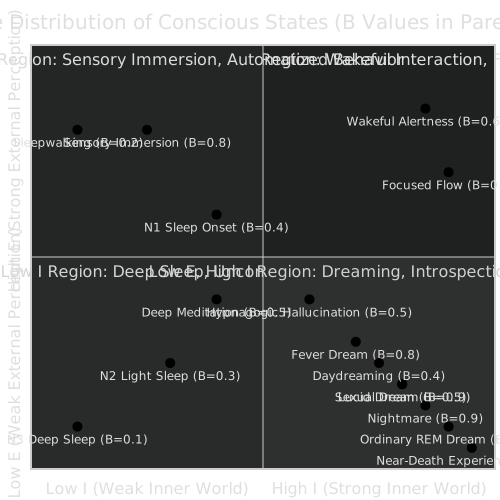
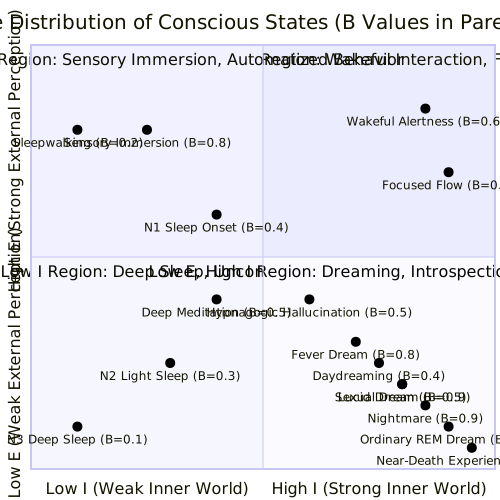
Diagram source
quadrantChart
title E-I Space Distribution of Conscious States (B Values in Parentheses)
x-axis "Low I (Weak Inner World)" --> "High I (Strong Inner World)"
y-axis "Low E (Weak External Perception)" --> "High E (Strong External Perception)"
quadrant-1 "High E, High I Region: Wakeful Interaction, Focused Tasks"
quadrant-2 "High E, Low I Region: Sensory Immersion, Automatized Behavior"
quadrant-3 "Low E, Low I Region: Deep Sleep, Unconsciousness"
quadrant-4 "Low E, High I Region: Dreaming, Introspection, Meditation"
"Wakeful Alertness (B=0.6)": [0.85, 0.85]
"Focused Flow (B=0.3)": [0.90, 0.70]
"Daydreaming (B=0.4)": [0.75, 0.25]
"Sensory Immersion (B=0.8)": [0.25, 0.80]
"Ordinary REM Dream (B=0.5)": [0.90, 0.10]
"Lucid Dream (B=0.5)": [0.80, 0.20]
"Nightmare (B=0.9)": [0.85, 0.15]
"Sexual Dream (B=0.9)": [0.80, 0.20]
"Fever Dream (B=0.8)": [0.70, 0.30]
"Hypnagogic Hallucination (B=0.5)": [0.60, 0.40]
"N1 Sleep Onset (B=0.4)": [0.40, 0.60]
"N2 Light Sleep (B=0.3)": [0.30, 0.25]
"N3 Deep Sleep (B=0.1)": [0.10, 0.10]
"Deep Meditation (B=0.5)": [0.40, 0.40]
"Near-Death Experience (B=0.9)": [0.95, 0.05]
"Sleepwalking (B=0.2)": [0.10, 0.80]
On this diagram we can see clearly:
Upper-right quadrant (high E, high I): wakeful alertness, focused flow, and other everyday conscious states. The information entropy of both E and I is high, B's is medium, and the A-network's regulatory output is high. This is the region of the highest .
Upper-left quadrant (low E, high I): the dream family (ordinary dream, lucid dream, nightmare, erotic dream, etc.). The E-network's information entropy is extremely low (the sensory gate is closed), but the transfer entropy is high (endogenous perception), and the I-network's information entropy is high. B's information entropy varies dramatically — extremely high in nightmares and erotic dreams (intense arousal), medium in ordinary and lucid dreams.
Lower-left quadrant (low E, low I): sleep stages (N1, N2, N3) and deep meditation. In N3 deep sleep, the information entropy of every network approaches zero (except B, which maintains an extremely low but non-zero baseline). Deep meditation, though low in both E and I information entropy, has high A-network regulatory output (maintaining a high degree of focused inhibition), forming a unique state of "low differentiation, prominent higher-order integration".
Lower-right quadrant (high E, low I): sensory immersion (such as dance and sport) has high B information entropy (intense bodily feeling); sleepwalking has high E information entropy but I approaching zero, with zero A regulatory output, reflecting its automatic and unconscious character.
The transitions among all these states are continuous information-dynamical pathways, verifying the unity of the spectrum of consciousness.
#8.7 Conclusion: The Kingdom of Dreams, the Territory of Order
Through this chapter's exploration, we have completed an epic voyage across all known forms of consciousness. From the rational light of wakefulness to the fantasy sea of dreams, from the boundless silence of deep sleep to the pure awareness of meditation, to the strange flashes at the edge of death — all of it is captured and explained by one and the same language, one and the same coordinate system, one and the same mathematics: information entropy describes the richness of content, transfer entropy the directed causal coupling, synergistic information the emergence of context, and the phase synchronization order parameter the unified sense of presence.
The E-I-B-A model and its core information-dynamical variables have successfully unified the myriad forms of consciousness into the emergent patterns of one and the same complex system under different conditions. The core contributions of this chapter are:
It precisely characterizes the information-dynamical nature of dreaming: dreaming is redefined as "a state of consciousness dominated by the transfer entropy and transfer entropy when the A-network's regulatory output is extremely low", clearly distinguishing external perception (high information entropy of E) from internal perception (high transfer entropy of ) — two fundamentally different sources of perceptual information.
It provides a unified explanatory framework for the dream family: from nightmares (the vicious positive feedback of and transfer entropy) to lucid dreams (local reactivation of the pathway by the A-network), from fever dreams (chaos driven by abnormal B-network information entropy) to erotic dreams (benign positive feedback of ), every dream variant is precisely located in information-dynamical parameter space.
It dissolves false binary oppositions: wakefulness and dreaming, normal and pathological, rational and mystical are no longer opposing poles, but different information-dynamical climate zones on the same continent of consciousness. Between them exist continuous, comprehensible transition paths. The difference between wakefulness and dreaming lies not in "whether consciousness is present", but in the driving source of perception (high information entropy of E vs. high transfer entropy of ) and the mode of regulation (A online vs. A offline).
How was this unified spectrum of consciousness ultimately formed? In the next chapter, we will carry this information-dynamical navigation system and formally sail into the sea of consciousness pathology, using the lens of E, I, B, A to analyze the imbalances and suffering that afflict the human mind.
【End of Chapter 8: the black-obsidian ground rises from medium to high gloss; the boundary between dream and wakefulness becomes discernible.】