
#Chapter 7: Visualization — A Dynamical Map of Everyday Consciousness
#7.0 Introduction: From Explanatory Theory to Navigation System — The Operational Revolution of Consciousness Dynamics
In the preceding six chapters, we have completed a grand expedition through philosophy, physics, mathematics, and neuroscience toward a theory of consciousness. We established consciousness as "relational process" ontology, identified the "global electromagnetic field" as its physical substrate and the "edge-of-chaos attractor" as its mathematical stage, and ultimately constructed the content model centered on the four-dimensional networks E, I, B, and A. Chapter 5 accomplished the critical mathematical turn: it operationalized the "richness" and "unity" of conscious content as information entropy and transfer entropy, synergistic information, and the phase synchronization order parameter, respectively, and provided a unified unit of consciousness measurement — "White-Cabbage-Rice." Chapter 6 then anchored each of these information variables to real neural structures.
A logically self-consistent, richly layered explanatory system now stands. Yet a fundamental challenge remains: how do we bring this profound theory out of the pages, transforming it into a practical tool capable of dissecting everyday experience, guiding empirical research, and even empowering individual introspection and growth?
This chapter launches the "operational revolution" of this theory. We will accomplish a decisive leap: transforming the "Rice Consciousness Theory" from an explanatory framework into a full set of operational, measurable, navigable "consciousness dynamics operating system."
This is not merely a static map. We will:
Establish an intuitive navigation interface: By defining the demand vector , the suppression vector , and the consciousness position vector — each component of which directly corresponds to the normalized transfer entropy (NTE) defined in Chapter 5 — every moment of experience is transformed into a traceable "dynamical point" within the three-dimensional E-I-B state space.
Redefine the deep structure of consciousness: Based on this framework, we will propose a clear dynamical definition of the "unconscious." It is no longer a mysterious repository, but rather the "gravitational terrain" formed by the self-organizing information flow of E-I-B when the regulatory output of the consciousness spotlight (A network — i.e., ) is weak or directed elsewhere.
Reveal the fundamental law of attention: We will formalize the "binary focus" principle of conscious resource allocation and the "triple conflict" state that arises when it fails, thereby providing a unified explanation for the everyday cognitive spectrum ranging from deep flow to distracted irritation.
Propose a groundbreaking empirical program: Ultimately, we will unveil the chapter's most central prediction and method — "trajectory mapping." By reconstructing the trajectory of from neural data, we can for the first time objectively present the subjective stream of consciousness as a computable entity with specific geometric and dynamical characteristics within state space. This is not merely validation of the theory, but the opening of a new scientific window for probing the invisible structure of the unconscious and quantifying phase transitions of conscious states.
Thus, we hold in our hands not merely a theory about "what consciousness is," but a practical star chart and navigation instrument for exploring and navigating the inner universe. Now, let us begin this journey from understanding the world to changing it.
#7.2 Three-Dimensional State Space: E, I, B as Axes
We construct a three-dimensional Cartesian coordinate system whose three orthogonal axes represent:
X-axis: I (Internal Recurrence) — from left (0, no inner thoughts) to right (1, fully immersed in the inner world).
Y-axis: E (External Projection) — from back (0, no external perception) to front (1, completely occupied by the external world).
Z-axis: B (Body Undertone) — from bottom (0, bodily sensation silent) to top (1, bodily sensation overwhelmingly dominant).
Thus, we obtain a unit cube with side length 1. Every point within this cube represents a possible state of conscious content uniquely determined by the information entropy activity ratio of E, I, and B (, , ).
Important Note: The A (Regulation) network does not directly appear as a spatial axis. This is because the A network in this model plays the role of director or navigator — it does not directly contribute fixed "content" but instead guides the state point's movement within this three-dimensional space by dynamically adjusting the normalized transfer entropy it outputs to E, I, and B (i.e., the result of the vs. negotiation). The activity of the A network is manifested in the morphology of the movement trajectory.
#7.3 Visualizing the Mathematical Mapping
This section aims to establish a direct correspondence between the information dynamics variables of Chapter 5 and the visualization framework of this chapter. We will not re-derive the formulas, but rather explain the mathematical origin and phenomenological significance of each visualization element.
#7.3.1 Core Vectors: Definition and Meaning of , ,
These three vectors are the pivot connecting mathematics and geometry. Chapter 5 (Section 5.5) rigorously defined them as functions of normalized transfer entropy (NTE), characterizing the information flow between the A network and the other three networks.
1. Demand Vector
Mathematical Origin (Chapter 5, Section 5.5.1): . Here is the normalized transfer entropy flowing from network X to network A.
Physical Meaning: Quantifies the bottom-up information "call" or "demand intensity" sent by the three content networks E, I, B to the A network (the "director"). High means external events are strongly capturing attention; high means bodily demands (e.g., pain, hunger) are competing for regulatory resources.
Visualization Meaning: The arrow points toward an unregulated, "instinctive" consciousness state. Its direction indicates which demand is most urgent; its length indicates total demand intensity.
2. Suppression Vector
Mathematical Origin (Chapter 5, Section 5.5.2): . Each component is a function constructed from the product of three factors (demand protection factor, noise defense factor, prior goal factor), with its core input still being the values of each channel.
Physical Meaning: Represents the top-down regulatory output of the A network — that is, the selective suppression that the A network applies to demands from different channels based on the current situation, long-term goals, and internal state. It is not a simple shutdown, but a dynamic filter based on global information optimization.
Visualization Meaning: represents the direction the system actively resists. It is the embodiment of the A network's "wisdom" and "strategy."
3. Consciousness Position Vector
Mathematical Origin (Chapter 5, Section 5.5.3): The endpoint of in E-I-B space directly corresponds to the net regulatory transfer entropy ultimately output by the A network:\ \ That is, where attention resources (in the form of information flow) are actually flowing at this moment.
Mathematical and Visualization Core: The endpoint of is the current conscious position in E-I-B state space. Its trajectory is precisely the stream of consciousness that we experience.
#7.3.2 The Visualization Meaning of Differentiation and Integration
We can directly understand these operations through vector motion, without repeating the formulas (see Chapter 5, Section 5.7 for details):
First derivative : Instantaneous velocity vector. It describes the speed and direction of the conscious state point's movement. A large magnitude indicates rapid switching of conscious content; a stable direction indicates coherent attention.
Second derivative : Instantaneous acceleration vector. It reveals changes in velocity, used to identify turning points (inflection points), such as critical moments when attention is about to collapse or suddenly focus.
First integral : The total displacement vector of the trajectory (time-weighted). It measures the overall allocation bias of attention over a period of time.
Second integral : The persistent inertia of the trajectory. It emphasizes long-term, stable patterns, corresponding to the accumulation of habits, skills, or chronic psychological states.
#7.3.3 Spatial Interpretation of Global Indicators , ,
Differentiation The distance of the state point from the origin. The greater the distance, the more highly active at least one of E, I, B is (i.e., its information entropy activity ratio is high), meaning conscious content is richer.
Integration The smoothness, coherence, and overall coordination of the trajectory. This reflects the underlying efficiency of second-order transfer entropy, the stability of third-order synergistic information, and the maintenance of fourth-order global phase synchronization . If the trajectory is a smooth curve rather than a random scatter of points, is high.
Consciousness intensity A "rich and coherent trajectory." High corresponds to the state point moving along complex but stable paths far from the origin; low corresponds to stagnation near the origin or chaotic jumping.
#7.4 Application Examples: Visual Interpretation of Everyday Conscious Phenomena
The power of the visualization framework introduced in this chapter lies in translating complex consciousness dynamics into geometrically intuitive motion. To demonstrate its application, we first provide a streamlined consciousness state comparison table using only the three core vectors , , and . These nine values (each vector contains the normalized transfer entropy intensity on the three dimensions E, I, B, ranging from 0 to 1) are already sufficient to capture the key characteristics of conscious states.
Subsequently, using "cycling (autopilot state)" as an example, we will present a full theoretical "consciousness dynamics panorama" incorporating temporal calculus at all orders and global indicators. Finally, we will argue that for most practical applications and intuitive understanding, the streamlined table is already powerful enough.
#7.4.1 Streamlined Consciousness State Table: Core Description with , ,
The table below lists several typical conscious states with exemplary values for their , , and vectors. These values are synthetic estimates based on model derivation and phenomenological observation, intended to qualitatively illustrate the dynamical landscape. Note: In empirical research, these values can be objectively obtained from EEG/MEG data by computing the normalized transfer entropy () of each channel.
| Event / State | O(t) (Demand Vector) | S(t) (Suppression Vector) | C(t)=O−S (Conscious Position) | Dynamical Notes |
|---|---|---|---|---|
| 1. Cycling (DMN Mode) | (0.9, 0.7, 0.9) | (0.6, 0.1, 0.4) | (0.3, 0.6, 0.5) | Dominant Interaction: High and high . Dynamics: Bodily rhythm (B) drives mind wandering (I), actively suppressing external interference (E). sits high on the I-B plane, with a smooth trajectory. |
| 2. Focused Programming (Flow) | (0.9, 0.9, 0.9) | (0.4, 0.2, 0.8) | (0.5, 0.7, 0.1) | Dominant Interaction: High (self-referential) and precise . Dynamics: High cognitive demand (), strong suppression of bodily interference (B) and irrelevant perceptions (). locks onto the high E-I plane. |
| 3. Late-Night Binge-Watching, Desperate Urination | (High E, Mid I, High B) Plot captivates (E high), minimal reflection (I mid), bladder pressure (B high) |
(Low E, Mid I, Low B) Emotion wants to continue (E suppression low), rationality (I) and bodily alarm (B) are raising E suppression, but still in negotiation |
(High E, ~Low I, High B) "Watching uncomfortably, can't bear to leave" |
Dominant Interaction: Fierce negotiation between and . Dynamics: Embodies the value conflict between short-term pleasure and long-term health. is small but directionally oscillating; the system is at an unstable equilibrium point. |
#7.4.2 Full Description Example: Cycling (Autopilot State) Dynamics Panorama
Using "entering an autopilot state while cycling" as an example, we present a full theoretical dynamics description. It must be emphasized that all values in the model between 0 and 1 are informational macro-statistical abstractions (normalized transfer entropy or activity ratios) of the extremely complex underlying neural activity. These values reflect the information transfer efficiency and content richness of each channel.
Key Premises:
Non-Zero Baseline: In a healthy living system, the baseline information entropy of the global electromagnetic field and each network is never zero. This corresponds to the spontaneous firing and baseline metabolic activity of neurons at rest. Zero means death of consciousness.
Root of Sensitivity: The human brain possesses nearly one hundred billion neurons and one quadrillion synapses, whose space of possible activity patterns is an astronomical number. When compressing and mapping such a vast state space into an interval of 0 to 1, subtle changes in every decimal place may correspond to significant reorganizations of the underlying neural cluster activity patterns. For example, a change in activity ratio from 0.312455 to 0.312567, though seemingly minuscule in macro indicators, could mark a shift in the dominant neural oscillation frequency or a turning point in coupling strength between key brain regions. This "decimal-point sensitivity" is an inherent property of the brain as a complex system at the edge of chaos, and is the physical basis for the continuity and subtlety of subjective experience.
1. Core Vectors and Their Time Evolution (at Stable State Moment )
| Variable | E Component | I Component | B Component | State Interpretation |
|---|---|---|---|---|
| (Demand) | 0.90 | 0.70 | 0.90 | External environment stable and familiar, low demand; free-flowing inner thoughts have moderate demand; maintaining rhythmic bodily movement has high demand. |
| 0.10 | 0.10 | 0.10 | Demand very stable, slight thought fluctuations. | |
| 0.10 | 0.10 | 0.10 | Acceleration present, slight thought fluctuations. | |
| (past ) | Cumulative load: bodily load dominant, cognitive load secondary. | |||
| Persistence effect of bodily demands most significant. | ||||
| (Suppression) | 0.60 | 0.10 | 0.40 | Active strategy: high suppression of attention to irrelevant environmental details ( high); greatly relaxed suppression of inner thoughts ( low); partial suppression of discomfort from repetitive bodily movements ( mid-low). |
| 0.10 | 0.10 | 0.10 | Suppression strategy in stable configuration. | |
| 0.10 | 0.10 | 0.10 | Acceleration present, slight thought fluctuations. | |
| (past ) | Cumulative suppression effort mainly used to filter environment. | |||
| Long-established habit pattern of "ignore environment, let thoughts drift." | ||||
| (Conscious Position) | 0.30 | 0.60 | 0.50 | Core Experience: "Body in motion, mind wandering." Conscious resources (i.e., A network's net NTE output) mainly allocated to internal narrative (I) and bodily rhythm (B), maintaining only minimal monitoring external (E). |
| 0.10 | 0.10 | 0.10 | Conscious position nearly stationary or drifting extremely slowly, embodying the stability of "autopilot." | |
| 0.10 | 0.10 | 0.10 | Acceleration present, slight thought fluctuations. | |
| (past ) | Long-term attention allocation pattern: introspection and embodiment dominant. | |||
| A stable personality or state trait: skilled at or habituated to introspection during physical activity. |
2. Global Consciousness Indicators
| Indicator | Value | ||||
|---|---|---|---|---|---|
| Differentiation | 0.95 | 0.10 | 0.10 | ||
| Integration | 0.95 | 0.10 | 0.10 | ||
| Consciousness Intensity | 0.9025 | 0.10 | 0.10 |
Example Dynamics Interpretation:
This state is a combination of "precise automation" and "chaotic sensitivity." On one hand, the subconscious circuits (e.g., E→B→motor control) maintain efficient self-organization through transfer entropy, managing balance like a precision instrument; on the other hand, the stable drift of the conscious system at the high I-B plane is built on a dynamical foundation that is extremely sensitive to minute perturbations (such as fluctuations in ). The regulatory strategy of the A network () is not fixed, but is continuously fine-tuned at rates characterized by the small derivatives to maintain this stable state. A minuscule change in any component's decimal place, if amplified by the system's positive feedback, could lead to a switch in conscious state (e.g., a sudden thought causing to surge, breaking the equilibrium).
#7.4.3 Why , , Are Already Sufficient: A Pragmatic Perspective
The cycling example vividly demonstrates that while we can construct a complete mathematical description including all calculus terms, the streamlined description consisting of the three vectors , , — each component of which is a computable normalized transfer entropy (NTE) — already captures the most essential and intuitive skeleton of consciousness dynamics.
Defines the "State-Drive" Pair of Consciousness: explicitly gives the "instantaneous coordinates" of consciousness in experience space (what is being experienced right now), while and jointly define the "net force" ( direction) driving changes. Knowing the position and the forces, the backbone of the dynamical picture is already clear.
Corresponds to Reportable Experience: These three vectors directly map onto what we can introspect and report:
- approximates "what is attracting or demanding me right now" (the body needs to pedal, thoughts want to wander).
- approximates "what I am actively ignoring or suppressing" (ignoring roadside billboards, not delving into a passing thought).
- is simply "my current experiential focus" (feeling the rhythm of cycling, while thinking about what to eat for dinner).
Is the Generative Basis for Higher-Order Indicators: The consciousness intensity , dependent on differentiation and integration , is essentially computed from the trajectory (history and present) of and the network interactions reflected in and . The streamlined vectors are the cause; the global indicators are the effect.
Therefore, the streamlined table (7.4.1) is a powerful tool for applying the theory to phenomenological understanding and practical intervention, while the full description (7.4.2) serves as the foundational proof of the theory's own logical rigor and completeness. The two complement each other.
#7.5 The Dynamical Meaning of the Unconscious: E-I-B Self-Organization and the Non-Intervention of the A Network
In the E-I-B-A model, the "unconscious" need not be regarded as a mysterious repository deep within the psyche. We can propose a clear definition consistent with information dynamics principles: The unconscious is the spontaneous, self-organizing information processing and pattern-generation process carried out by the three content networks E, I, and B through their intrinsic neural connections and electromagnetic field coupling, when the A network's instantaneous modulation output is extremely weak (i.e., approaches zero) or directed elsewhere.
This definition reveals two core characteristics of the unconscious:
The Operating Agent Is the Content Networks Themselves: The physical substrate of unconscious activity remains the same brain regions and networks that constitute perception, introspection, and bodily sensation (E, I, B). Their anatomical connections and physiological couplings form the "hardware foundation" of unconscious computation, maintaining a certain level of information entropy and transfer entropy among themselves.
The Key Is the Absence of Modulation: The A network's role is like the "spotlight" and "director" of the theater of consciousness. When this spotlight does not illuminate a particular E-I-B synergistic pattern (i.e., that pattern does not receive sufficient gain), that pattern resides in the dark of consciousness — that is, in the unconscious. It may still be autonomously operating and evolving, even influencing other patterns through transfer entropy, but its content does not constitute clear conscious experience in the present moment.
#7.6 The "Binary Focus" Principle and the "Triple Conflict" State
From introspective observation of everyday consciousness, we can distill a universal phenomenon: in most cognitively demanding tasks, clear consciousness appears to naturally favor a "binary dominance" configuration.
E-I-B-A Model Explanation: The Optimal Resource Allocation of the A Network
This phenomenon may stem from the nature of the A network (prefrontal-parietal executive control network) as a "resource-limited modulator." To establish a clear, stable, and efficient global working state, the most economical strategy for the A network is to concentrate its limited normalized transfer entropy output () onto two content networks, fostering a strong and stable synergistic channel between them, while relatively suppressing the activity of the third network to reduce its interference.
From this, we can define several core "conscious attitudes":
Cognitive-Perceptual Attitude (E-I Plane): points near the E-I axis. and are high, is low. Examples: deep reading, problem-solving.
Introspective-Embodied Attitude (I-B Plane): points near the I-B axis. and are high, is low. Examples: immersed in recollection or anxious rumination, absent-minded toward the external environment.
Sensory-Motor Attitude (E-B Plane): points near the E-B axis. and are high, is low. Examples: dancing, sports, or savoring food.
The "Triple Conflict" State: Exception and Validation of the Principle
However, the scenario of "intense urgency to urinate while binge-watching a show" constitutes a critical exception to the "binary focus" principle. Here, the captivating plot (high ), the cognitive/emotional engagement with the story (high ), and the bladder pressure (high ) all simultaneously make strong demands for conscious access. If the A network fails to decisively raise suppression (S) on one (or more) dimensions, the system falls into a "triple conflict" state. This is the inevitable consequence when the A network's information channel capacity cannot simultaneously satisfy three high-intensity demands.
#7.7 Trajectory Mapping: An Empirical Window into Consciousness Dynamics
One of the most revolutionary empirical predictions of the E-I-B-A model is that consciousness, as a dynamical process, should exhibit specific, non-random geometric and statistical characteristics in the motion trajectory of its state within the three-dimensional E-I-B space. Based on this, we propose an empirical research program called "trajectory mapping."
Methodology Core
Data Translation: Using multimodal neuroimaging data (e.g., EEG source localization, fMRI dynamic functional connectivity, MEG network analysis), combined with behavioral task paradigms and first-person reports, develop algorithms to approximate estimation of an individual's vector at consecutive time points. According to Chapter 5 (Section 5.5.3), the three components of are:\ \ This vector represents the net information transfer from the A network to the other three networks — the instantaneous position of the "regulatory hand" of consciousness.
Trajectory Construction: Connect these time-series coordinate points sequentially within the E-I-B state cube, forming a continuous (or high-density sampled) three-dimensional trajectory curve extending through time. This curve is the "consciousness regulation trajectory."
Dynamical Analysis: Subject this trajectory curve to nonlinear time-series analysis (e.g., computing Lyapunov exponents, correlation dimension, multiscale entropy) and topological analysis to quantify its stability, complexity, and attractor structure.
The "Four-Body Problem" of the Consciousness Universe: From Dark Matter Terrain to Visible Trajectory
Trajectory mapping reveals a deeper dynamical picture: the consciousness system is akin to a "four-body" gravitational system. The A network is a special and powerful "regulatory star," whose motion trajectory is . The three main stars E, I, B, and the interaction terms among them constitute an invisible yet omnipresent gravitational background — the "unconscious terrain." The mass distribution of this terrain is determined by the structural capacity (information entropy upper bound ) of each network, while the gravitational channels between them are determined by the maximum transfer entropy (, corresponding to the information bandwidth of anatomical connections). The trajectory of is precisely the path of this regulatory star navigating through this dark matter terrain.
Expected Key Findings and Theoretical Validation
Direct Manifestation of Attractors: In a stable conscious state, the trajectory will undergo aperiodic motion around one or more specific "regions," forming a dense "trajectory cloud." The geometric core of this cloud is the "dynamical attractor" corresponding to that conscious state.
Evidence of the Edge of Chaos: High-quality waking consciousness or flow states should exhibit characteristics of a "chaotic attractor": the trajectory is complex, never precisely repeats (aperiodic), yet remains confined within a bounded region.
Phase Transition Observation of State Switching: Switching between conscious states (e.g., from rest to task, or from daydreaming to alertness) will manifest on the trajectory as a rapid "jump" or "trajectory bifurcation."
Inverse Inference of the Unconscious Terrain: Most groundbreakingly, by analyzing the long-term motion patterns, lingering regions, and avoided regions of the trajectory, we can inversely infer the invisible "dark matter terrain" behind it, constituted by the structural capacity and maximum transfer entropy .
#7.8 Chapter Conclusion: From Static Map to Navigation Instrument for the Dynamical Universe
Through the step-by-step construction of this chapter, we have transformed the "Rice Consciousness Theory" from an elegant mathematical formalism into a multi-layered, operational exploration and navigation system that resonates deeply with our first-person experience.
We possess an "intuitive mental navigation map": The three-dimensional state space and the vector system — each component anchored to computable normalized transfer entropy () — enables us to structurally examine and describe our own ever-changing conscious states.
We have obtained a "deep explanatory framework":
- It clearly redefines the unconscious (7.5), elucidating it as the invisible universe constituted by the self-organizing information flow of E, I, and B, existing beyond the scope of the consciousness spotlight ().
- It formalizes the fundamental law of attention and its exceptions (7.6), explaining the "binary" steady state of efficient focus and the "triple conflict" dynamics of resource saturation.
- Through "trajectory mapping" and the cosmological metaphor of the "four-body problem" (7.7), it seamlessly weaves consciousness (the regulatory trajectory of A) and the unconscious (the information gravitational terrain of E-I-B) into the same dynamical picture.
We have built a "solid bridge to empirical research and application": "Trajectory mapping" points toward a series of testable hypotheses for the future: the geometric existence of conscious attractors, quantitative evidence of the edge of chaos, abnormal trajectories in pathological states, and most excitingly — the computational reconstruction of the unconscious terrain.
From our Copernican revolution regarding the ontology of consciousness, through the exploration of the physical substrate, the forging of the mathematical model, and the grounding of neural anchoring, we have arrived not merely at a theory about "what consciousness is," but at a practical instrument for exploring and navigating the inner universe.
Now, let us grip this navigation chart tightly, and aim its coordinates and compass at the most mysterious and regular variation of consciousness — the realm of dreams. In the next chapter, we will witness that from waking to sleeping, from logic to absurdity, is merely the eternal variations of the same information dynamics language, composed under different parameters.
Chapter 7 Complete: Luster emerges on the obsidian ground, details growing clearer, the terrain more three-dimensional.]
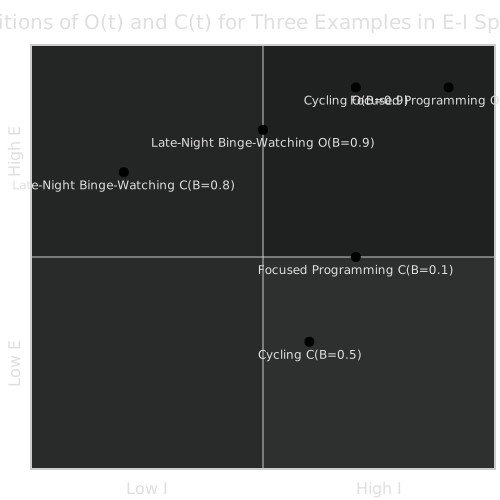
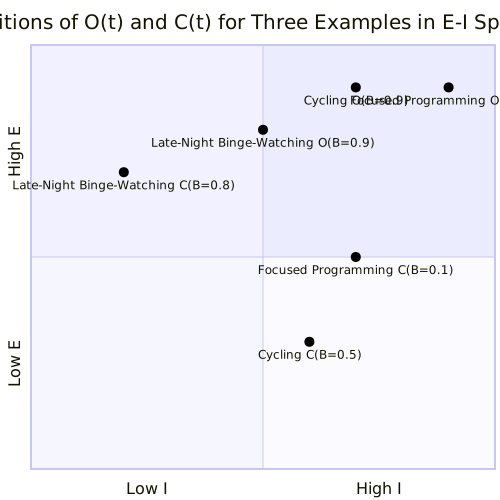
Diagram source
quadrantChart
title Positions of O(t) and C(t) for Three Examples in E-I Space
x-axis "Low I" --> "High I"
y-axis "Low E" --> "High E"
"Cycling O(B=0.9)": [0.7, 0.9]
"Cycling C(B=0.5)": [0.6, 0.3]
"Focused Programming O(B=0.9)": [0.9, 0.9]
"Focused Programming C(B=0.1)": [0.7, 0.5]
"Late-Night Binge-Watching O(B=0.9)": [0.5, 0.8]
"Late-Night Binge-Watching C(B=0.8)": [0.2, 0.7]