
#Chapter 10: Chemical Modulation — How Exogenous Substances Intervene in the Information-Dynamics System
Note on the numbers: The numerical values in this chapter — "consciousness intensity X Rice", receptor-affinity multiples, conduction-delay milliseconds, etc. — are partly literature-based (e.g. fentanyl's μ-receptor affinity being 50–100× that of morphine), while the rest (especially all "Rice" values) are illustrative reference values intended to compare the relative magnitudes of states induced by different substances; they are not all measured data. The reader should treat them as order-of-magnitude illustrations, not precise measurements.
Methodological note: This chapter follows the methodology of Chapter 9.1 — all "fault-mode correspondences" and "treatment implications / treatment potentials" are hypotheses, whose truth depends on whether they can be falsified by the following falsifiable predictions. The judgment standard ("if it is wrong, what would we measure?") is the same as in Chapter 9, and is not repeated here.
#10.0 Introduction: From Endogenous Faults to Exogenous Intervention
In Chapter 9 we examined endogenous faults — the pathological attractors into which the consciousness system falls, without external chemical intervention, due to drift of its information-dynamical parameters, structural damage, or developmental deviation. Depression's B-I trap, schizophrenia's repellor reversal, Alzheimer's structural-capacity decline — these are paths the system walks itself.
Chapter 10 turns to exogenous perturbations.
Every psychoactive substance — caffeine, alcohol, nicotine, LSD, cocaine, fentanyl — does not create new conscious states out of nothing. They are external knobs inserted into the E-I-B-A information-dynamical console, artificially inducing or correcting the six basic fault modes defined in Chapter 9 by interfering with specific information-dynamical parameters.
From this perspective:
- Addictive substances are "manufacturers of trap-type faults (Ⅰ)" — they artificially push the NTE of specific pathways to abnormally high values and drive their decay coefficient λ→0.
- Psychedelics are "inducers of repellor reversal (Ⅲ) and coupling breakdown (Ⅳ)" — they interfere with the timing of the self-labeling function of NTE_{I→E} and locally collapse R_EIBA.
- Stimulants are "promoters of shallow-dish faults (Ⅱ)" — they flatten repellors, sharply lowering the minimum NTE threshold the A network needs to hold C(t) stable.
- Therapeutic drugs are "correction tools for specific fault modes" — they correct NTE deviations from baseline, or restore a healthy information-entropy baseline.
This is not a new language, but a re-examination of all psychoactive substances through the pathological information-dynamical framework already built in Chapter 9. Drugs, diseases, and normal conscious states are now all drawn onto the same information-dynamical map.
#10.1 A Mapping of Chemical-Modulation Information-Dynamical Parameters
| Ch. 9 fault mode | Intervened information-dynamical parameter | Drug action | Representative substances |
|---|---|---|---|
| Ⅰ Trap | Specific NTE_{X→Y} pushed abnormally high, decay coefficient λ→0 | Enhance specific transfer-entropy coupling (e.g. NTE_{E→B}, NTE_{B→I}), structurally engrave reward pathways | Cocaine, heroin, nicotine, alcohol (chronic) |
| Ⅱ Shallow-dish | Minimum NTE threshold for holding C(t) stable drops sharply | Flatten repellors, lower state-switching threshold, C(t) dwell time decays exponentially | Amphetamine (high dose) |
| Ⅲ Repellor reversal | NTE_{I→E} self-labeling fails (efference-copy delay Δt exceeds sync window) | Interfere with I→E efference-copy conduction timing, destabilize R_EIBA locally | LSD, psilocybin, ketamine, cannabis (high dose) |
| Ⅳ Coupling breakdown | Specific NTE_{X→Y} deviates from healthy baseline | Selectively enhance or weaken specific network-to-network normalized transfer entropy | Nicotine (enhances NTE_{A→E}), alcohol (weakens global NTE) |
| Ⅴ Structural-capacity decline | H_max(X) irreversibly shrinks | Neurotoxicity causes irreversible decline of maximum information entropy | MDMA, chronic alcohol abuse, chronic stimulants |
| Ⅵ Slow-variable instability | Global NTE baseline oscillates between stable states | Interfere with neuromodulatory negative-feedback loops, making global NTE baseline drift between high and low | Bipolar-inducing drugs, SSRI withdrawal |
Core claim: all psychoactive substances — regardless of source, structure, receptor, or molecular size — can ultimately be reduced to information-dynamical intervention on these six fault modes. Their differences lie not in "which molecular path they take", but in which fault mode they induce or correct, their selectivity, and their reversibility.
#10.2 Manufacturers of the Trap-Type Fault: The Common Logic of Addictive Substances
#10.2.1 Cocaine, Amphetamine — Ultra-Rapid Engraving of the Reward Trap
Cocaine and amphetamine, by blocking the dopamine transporter or promoting dopamine release, drive synaptic dopamine concentration to more than 10× the physiological reward level. Information-dynamically, dopamine is the slow-variable knob of the global gain field — it pushes the gain of all D1/D2-regulated normalized transfer entropy (NTE) to the limit.
Fault mode: Ⅰ Trap + Ⅳ coupling breakdown (abnormal enhancement)
- NTE_{E→B} (environmental cue → craving) structurally engraved to abnormally high values.
- NTE_{B→I} (pleasure → memory) super-physiologically enhanced.
- Decay coefficient λ→0: in normal learning, unreinforced NTE pathways decay over time (λ>0), but addictive substances drive the reward loop's λ toward zero, forming a permanent transfer-entropy engraving.
Information-dynamical phenotype: the addiction attractor lies at the E-B-I junction, with escape time approaching infinity.
Treatment prediction (falsifiable): if the "structural engraving" mechanism holds, then when an addict is exposed to drug cues, the nucleus-accumbens–prefrontal functional connectivity should significantly increase, and the increase should correlate positively with craving intensity; if craving appears but connectivity does not change, the "structural engraving" mechanism is falsified.
#10.2.2 Opioids (Heroin, Fentanyl) — the Deep Trap of a Single Exposure
Opioids do not act directly on dopamine neurons; they inhibit GABAergic interneurons in the VTA, releasing the brake on dopamine neurons (disinhibition). The result is the same as stimulants: NTE_{E→B} and NTE_{B→I} surge super-physiologically.
Fault mode: Ⅰ Trap (extreme version)
- Sharp rise of NTE_{B→I}: opioids push the efficiency of the pleasure–memory transfer entropy to an upper bound evolution never set; a single use can form a deep engraving.
- Sharp drop of NTE_{A→B}: the A network's inhibitory transfer entropy to the B network is weakened — the effective regulatory efficacy of A→B is paralyzed; the addict cannot use "reason" to fight craving.
Special risk: high-dose opioids suppress the brainstem respiratory center — the most primitive, sub-conscious life-maintenance function of the B network. Death is not a side effect, but the inevitable result of the B network being pushed beyond the boundary of the information-dynamical parameter space.
Fentanyl's category crisis: fentanyl's μ-receptor affinity is about 50–100× that of morphine, with extremely high lipid solubility. Information-dynamically, this means a higher peak NTE_{B→I}, escape time approaching infinity (one use is a trap), and an extremely low therapeutic index.
Treatment prediction (falsifiable): if the "single-exposure deep trap" holds, then after a single opioid use, the anterior-insula–medial-prefrontal functional connectivity should already have increased and recover slowly; if no such change appears after a single use, the mechanism is falsified.
#10.2.3 Nicotine — the Locksmith of the Trap
Nicotine activates α4β2 nicotinic acetylcholine receptors, promoting the release of multiple neurotransmitters.
Fault mode: acute phase Ⅲ (optimizing A-network regulation, the therapeutic window); chronic phase Ⅰ Trap
- Acute: enhances NTE_{A→E} (A-network regulation of perception rises), corresponding to improved attention.
- Chronic: repeated activation structurally engraves NTE_{E→B} (cue → craving) into white matter.
Treatment prediction (falsifiable): if the "chronic engraving" mechanism holds, then long-term smokers should have higher FA in the anterior-cingulate–nucleus-accumbens pathway than never-smokers, and this should correlate positively with addiction severity; if FA shows no difference or no correlation with severity, the "structural engraving" mechanism is falsified.
#10.2.4 Alcohol (Chronic) — the Chronic Structural Trap
Fault mode: Ⅰ Trap + Ⅴ structural-capacity decline
Chronic alcohol exposure, through GABA-receptor modulation and neurotoxicity, causes structural changes in specific circuits. Long-term use causes irreversible decline of prefrontal–limbic NTE — the regulatory efficacy of NTE_{A→B} and NTE_{A→I} permanently drops. Withdrawal produces rebound traps (anxiety, craving), because the NTE_{B→I} that alcohol suppressed rebounds to abnormally high values after the inhibition is removed.
Treatment prediction (falsifiable): if the "chronic structural trap" holds, then long-term alcohol abusers should have significantly lower prefrontal–amygdala FA than controls, and this should correlate negatively with years of drinking; if FA shows no difference, the mechanism is falsified.
#10.3 Inducers of Repellor Reversal and Coupling Breakdown: Psychedelics and Dissociatives
#10.3.1 LSD, Psilocybin — the Dissolution of the Self-Boundary
LSD and psilocybin are potent 5-HT₂A agonists. This receptor is densely distributed on the apical dendrites of layer-V pyramidal neurons; its activation increases spontaneous random activity in cortical networks — the equivalent of forcibly pushing the whole-brain spectral-entropy baseline higher, shifting the edge-of-chaos balance away from the normal critical point.
Fault mode: Ⅲ Repellor reversal + Ⅳ coupling breakdown
(1) Repellor reversal (type-Ⅲ fault): psychedelics interfere with the conduction timing of the NTE_{I→E} efference copy, making its delay exceed the sync window (normally < 10 ms), so the self-labeling function of NTE_{I→E} temporarily fails — endogenous information is mislabeled as exogenous. This is exactly isomorphic with Chapter 9's definition of schizophrenia (only acute and reversible).
(2) Coupling breakdown (type-Ⅳ fault): functional connectivity within the DMN (the core carrier of the I-field) drops, while its separation from other networks collapses. The γ phase-locking value between the posterior cingulate and medial prefrontal cortex — i.e. the local contribution to R_EIBA — is significantly below baseline, and the magnitude of the drop correlates with "ego-dissolution" scale scores.
(3) Global surge of information entropy: the mechanism of synesthesia is abnormal cross-modal NTE enhancement between sensory cortices — not new white-matter channels, but a global elevation of cortical excitability by ascending modulation fields, amplifying previously sub-threshold NTE to super-threshold.
Treatment prediction (falsifiable): if the "repellor reversal" mechanism holds, then LSD-induced "ego-dissolution" subjective scores should correlate positively with the magnitude of the drop in posterior-cingulate–medial-prefrontal γ phase-locking; if ego-dissolution occurs but γ synchronization does not change, the "R_EIBA local collapse = self-boundary dissolution" mechanism is falsified.
#10.3.2 Ketamine — the Extreme Version of Coupling Breakdown
Ketamine is an NMDA-receptor antagonist acting mainly on NMDA receptors on GABAergic interneurons, causing reduced GABA release → cortical disinhibition → uncontrolled surge of whole-brain spectral entropy.
Fault mode: Ⅳ coupling breakdown + Ⅲ repellor reversal
- Bidirectional failure of NTE_{I→E} and NTE_{E→I}: prefrontal–temporal long-range γ synchronization is broken — information cannot be effectively transferred between the I and E networks.
- The high-dose "dissociative state" (K-hole) is the extreme manifestation of the temporary collapse of R_EIBA (the global phase-synchronization order parameter) — the I₄ field temporarily disintegrates, the unified self-sense disappears.
Treatment prediction (falsifiable): if the "R_EIBA temporary collapse" holds, then when high-dose ketamine induces the K-hole (dissociative state), prefrontal–temporal γ synchronization should drop to near zero; if the dissociative experience occurs but γ synchronization does not drop, the mechanism is falsified.
#10.3.3 Cannabis (High Dose) — Context-Dependent Chaos Induction
CB₁ receptors are mainly distributed on the axon terminals of GABAergic neurons; their activation inhibits GABA release, equivalent to local disinhibition — local spectral entropy rises in specific regions.
Fault mode: dose-dependent, individual-dependent
- Low dose: specific-pathway NTE moderately rises, spectral entropy gently elevates — similar to a mild type Ⅲ (increased association, enhanced perception).
- High dose: can induce type-Ⅲ repellor reversal — the self-labeling function of NTE_{I→E} locally fails, inner speech misjudged as another's voice.
- Effect instability: THC does not uniformly enhance or suppress the cortex, but increases the information-entropy variability of local networks — the chaotic sensitivity of the C(t) trajectory is locally amplified. This explains why the same person, same dose, in different contexts can experience relaxation, creativity, anxiety, or paranoia.
Treatment prediction (falsifiable): if "context-dependent chaos induction" holds, then for the same person and same THC dose, the local-network spectral-entropy variability in an anxious context versus a relaxed context should differ significantly; if the effect is stable across contexts, the "local amplification of chaotic sensitivity" mechanism is falsified.
#10.4 Inducers and Treaters of the Shallow-Dish Fault
#10.4.1 Amphetamine (High Dose) — Repellor Collapse and Trajectory Overspeed
Dopamine overload flattens the repellor gradient — the minimum NTE threshold the A network needs to hold C(t) stable drops sharply, switching cost approaches zero.
Fault mode: Ⅱ Shallow-dish (completely isomorphic with Chapter 9's mania)
- C(t) trajectory jumps at high speed, dC/dt significantly above baseline.
- Repellors between attractors universally collapse; the system loses the inertia of "this state is not yet processed; should not switch".
Treatment prediction (falsifiable): if "repellor collapse" holds, then under high-dose amphetamine the task-state dwell-time distribution should show exponential decay (no long-dwell tail); if the distribution remains a power law, the mechanism is falsified.
#10.4.2 Methylphenidate (Ritalin) — the Corrector of the Shallow-Dish Fault
Methylphenidate blocks dopamine and norepinephrine transporters, but acts gently, staying within the therapeutic window.
Fault mode: reverse intervention on Ⅱ Shallow-dish
ADHD patients' problem is the drop in the "effective value" of NTE_{A→E} and NTE_{A→I}, mainly due to insufficient superior-longitudinal-fasciculus conduction efficiency (FA ↓ → TE_max ↓). Methylphenidate does not change FA, does not repair the physical upper bound of the waveguide, but enhances the amplitude of the β modulation signal, so that even after attenuation the signal can still effectively drive the target — enhancing the effective transfer entropy of NTE_{A→E} and NTE_{A→I} at the source to compensate for the information-transmission loss caused by the drop in channel capacity (TE_max).
Treatment prediction (falsifiable): after methylphenidate treatment, the task-state dwell-time distribution of ADHD patients should recover from exponential decay to a power law (same as Chapter 9.3.1); if behavior improves but the distribution remains exponential, the mechanism is falsified.
#10.5 Coupling-Structure Reshapers: The Information-Dynamical Essence of Therapeutic Drugs
#10.5.1 SSRI — the Slow-Variable Strategy for Weakening the Type-Ⅰ Trap
Fault mode: chronic weakening of Ⅰ Trap (self-locking closed loop)
- (1) Restoring the B network's spectral-entropy baseline: the healthy anterior insula is dominated by the α band (moderate spectral entropy, "connectable but unoccupied"). In depression, anterior-insula θ power is abnormally elevated — spectral entropy drops, power concentrated in a single band. SSRI shifts the B network's oscillation baseline from θ back to α, restoring spectral entropy to a moderate level and reducing the probability of the over-locked transfer entropy of B→I and I→B forming.
- (2) Chronic weakening, not direct destruction: SSRI does not directly break the existing over-coupling of NTE_{B→I} and NTE_{I→B}; it lowers the probability of new traps forming. This explains the delayed onset (weeks are needed for the slow-variable system to complete baseline drift and for neural plasticity to recalibrate NTE).
Treatment prediction (falsifiable): if the "θ→α baseline shift" mechanism holds, then after SSRI treatment the anterior-insula θ power should significantly decrease and α power recover; if θ power does not change while mood improves, the mechanism is falsified.
#10.5.2 Lithium — the Stabilizer of Type-Ⅵ Slow-Variable Instability
Fault mode: correction of Ⅵ slow-variable modulation instability
The neuromodulatory systems (dopamine, etc.) of bipolar patients switch periodically between two stable states — one over-gaining all transfer-entropy channels (manic), the other paralyzing key pathways' NTE efficacy (depressive).
Lithium increases the negative-feedback gain of the slow-variable system, turning bistability into monostability, or raising the switching threshold — i.e. stabilizing the global NTE baseline so it no longer drifts between the two extremes.
Treatment prediction (falsifiable): untreated bipolar patients' global NTE baseline should show a bimodal distribution; after lithium treatment it should turn unimodal (same as Chapter 9.6.1); if it is unimodal before treatment, the mechanism is falsified.
#10.5.3 Antipsychotics — Inhibitors of Types Ⅲ and Ⅳ
Fault mode: inhibition of Ⅲ repellor reversal + Ⅳ coupling breakdown
D₂-receptor antagonism compresses the dopamine gain field:
- Lowering the gain of NTE_{E→B} and NTE_{B→I}, compressing the basin depth of pathological attractors.
- Not repairing the arcuate-fasciculus FA (i.e. not repairing TE_max(I→E)), but, by down-regulating overall cortical excitability, extending the sync-window tolerance of the NTE_{I→E} efference copy — so that even a delayed efference copy can still partially perform the self-labeling function.
Treatment prediction (falsifiable): after antipsychotic treatment, the N100 self/external difference of schizophrenia patients should partially recover; if hallucinations decrease but N100 does not change, the "extending the sync window" mechanism is falsified.
#10.6 Inducers of Structural-Capacity Decline: Irreversible Damage
#10.6.1 MDMA, Long-Term Alcohol Abuse — the Chronic Erosion of H_max
Neurotoxicity causes neuron death and synaptic loss → irreversible shrinkage of state-space volume → fewer distinguishable stable field modes → permanent atrophy of H_max(X).
Fault mode: Ⅴ structural-capacity decline
- The maximum information entropy of each network monotonically decreases over time, uncompensable by neural plasticity.
- EEG spectral slope steepens, high-frequency power (β/γ) preferentially attenuates, low-frequency power (δ/θ) relatively dominates — direct evidence of reduced information-dynamical degrees of freedom.
- Isomorphism with Alzheimer's: exogenous toxins and neurodegenerative diseases ultimately share the same terminal path — the irreversible erosion of the H_max matrix.
Treatment prediction (falsifiable): if "structural-capacity decline" holds, then the EEG multiscale entropy (MSE) of MDMA or long-term alcohol abusers should be significantly lower than controls, and correlate negatively with abuse severity; if MSE shows no difference, the mechanism is falsified.
#10.7 The Dynamics of Treatment: The Information-Dynamical Implementation of the Four Intervention Strategies
Corresponding Chapter 9's "two-level statement of the four intervention strategies" to the drugs discussed in this chapter, and restating them in information-dynamical language:
| Intervention strategy | Information-dynamical target | Drug examples | Corresponding fault mode |
|---|---|---|---|
| Ⅰ Weaken the pathological attractor | Lower the specific pathological pathway's NTE_{X→Y}, break abnormal phase-locking, so the system can escape the trap | SSRI, antipsychotics | Ⅰ, Ⅲ |
| Ⅱ Strengthen the healthy attractor | Build new high-NTE pathways, raise the normalized transfer entropy of target pathways, deepen the competitive basin | Behavioral activation (non-drug) | Ⅱ (reverse) |
| Ⅲ Optimize A-network regulation | Restore the effective efficacy of NTE_{A→E}, NTE_{A→I} (compensating for the TE_max drop caused by FA ↓) | Methylphenidate, high-frequency rTMS | Ⅱ (correction) |
| Ⅳ Reshape coupling structure | Correct specific-pathway NTE_{X→Y} deviation — pull overly high or low normalized transfer entropy back to the healthy baseline | Psychotherapy, DBS, psychedelics (experimental) | Ⅲ, Ⅳ |
Core claim:
All effective drug treatments must ultimately be realized as corrections of the information-dynamical parameters involved in Chapter 9's six fault modes. The difference in efficacy lies not in "which molecular path is taken", but in:
Which information-dynamical parameter is corrected (NTE, λ, H_max, R_EIBA)
What selectivity is achieved (global or pathway-specific)
How long it is maintained (acutely reversible or chronically structural)
What the cost is (side effects, tolerance, addiction, structural-capacity decline)
| State category | Main fault mode / information-dynamical feature | Consciousness intensity ★(t) | Representative example | Key information-variable features |
|---|---|---|---|---|
| Normal waking | None (edge of chaos; E/I/B/A information entropy and NTE balanced) | 1.0 Rice (baseline) | Healthy adult | High A-network regulatory output; NTE_{I→E} efference copy within the sync window; R_EIBA stable |
| Endogenous disorders | ||||
| Depression | Ⅰ Trap (NTE over-locking) | 0.3–0.6 Rice | — | NTE_{B→I}, NTE_{I→B} abnormally elevated and locked; B-network spectral entropy drops (θ-dominant); NTE_{A→B}, NTE_{A→I} efficacy attenuated (phase mismatch) |
| ADHD | Ⅱ Shallow-dish (NTE_{A→X} gain insufficient) | 0.4–0.7 Rice (fluctuating) | — | Effective values of NTE_{A→E}, NTE_{A→I} drop (TE_max insufficient due to superior-longitudinal-fasciculus FA ↓); C(t) dwell time decays exponentially |
| Schizophrenia | Ⅲ Repellor reversal + Ⅳ coupling breakdown | 0.5–0.8 Rice (abnormal quality) | — | NTE_{I→E} self-labeling fails (arcuate-fasciculus FA ↓, efference-copy delay exceeds sync window); R_EIBA locally collapses; NTE_{E→I} and NTE_{I→E} imbalanced |
| Autism | Ⅰ Trap + Ⅳ (NTE_{I→E}, NTE_{E→I} imbalance) | 0.4–0.7 Rice | — | NTE_{I→E} relatively too strong, NTE_{E→I} relatively too weak; I-network internal model rigid, hard to update by prediction error |
| Alzheimer's | Ⅴ Structural-capacity decline (H_max(X) irreversibly drops) | Decreases over time → 0 | — | Spectral entropy of each network irreversibly declines; EEG spectral slope steepens, high-frequency power attenuates; R_EIBA ultimately collapses |
| Bipolar disorder | Ⅵ Slow-variable instability (global NTE baseline oscillation) | Periodic fluctuation | — | Manic phase: global NTE gain too high, repellor collapse; depressive phase: NTE_{A→B}, NTE_{A→I} efficacy paralyzed, B-I over-locking |
| Exogenous drugs | ||||
| Opioids (acute) | Ⅰ Trap (acutely induced, positive valence) | 0.6–0.9 Rice (positive valence) | Heroin, fentanyl | NTE_{B→I} surges super-physiologically; NTE_{A→B} drops sharply |
| Stimulants (chronic addiction) | Ⅰ Trap (chronic engraving) | 0.5–0.8 Rice (craving-dominated) | Cocaine, amphetamine | NTE_{E→B}, NTE_{B→I} structurally engraved; FA ↑, λ→0 |
| Amphetamine (high dose) | Ⅱ Shallow-dish (induced) | 0.8–1.1 Rice (high speed) | — | Repellor collapse, dC/dt ↑↑; C(t) dwell time decays exponentially |
| Methylphenidate (therapeutic dose) | Ⅱ Shallow-dish (correction) | Recovers to 0.8–1.0 Rice | Ritalin | Enhances effective NTE_{A→E}, NTE_{A→I}; C(t) dwell time recovers power law |
| LSD / psilocybin | Ⅲ + Ⅳ (induced) | 0.7–1.2 Rice (abnormal quality) | — | NTE_{I→E} self-labeling temporarily fails; whole-brain spectral entropy surges; R_EIBA selectively drops |
| Ketamine | Ⅳ + Ⅲ (induced) | 0.5–0.9 Rice (fluctuating) | — | NTE_{I→E} and NTE_{E→I} bidirectionally fail; R_EIBA temporarily collapses at high dose |
| Cannabis (high dose) | Ⅲ (context-dependent) | 0.5–0.9 Rice (fluctuating) | — | Local spectral-entropy variability increases; NTE_{I→E} self-labeling locally fails |
| Nicotine (acute) | Ⅳ (selective enhancement) | 0.8–1.1 Rice | — | NTE_{A→E} ↑ |
| Alcohol (acute) | Ⅳ (global weakening) | 0.3–0.7 Rice (dose-dependent) | — | Global NTE ↓; C(t) contracts toward the origin |
| MDMA / long-term alcohol | Ⅴ (chronic erosion) | Decreases with duration of use | — | H_max(X) irreversibly drops; spectral simplification, high-frequency power attenuation |
| SSRI | Ⅰ weakening (chronic) | Slow recovery | — | B-network spectral-entropy baseline recovers from θ to α; lowers the probability of NTE_{B→I}, NTE_{I→B} over-locking |
| Lithium | Ⅵ stabilization | Stable | — | Stabilizes the global NTE gain baseline, preventing bistable oscillation |
| Normal variants | ||||
| Ordinary dream | Ⅳ (temporary, I→E dominant) | 0.4–0.6 Rice | — | A-network regulatory output very low; NTE_{I→E} (endogenous perception) dominant; NTE_{I→B} active |
| Lucid dream | Ⅳ (I→E dominant + A partial restart) | 0.7–0.9 Rice | — | NTE_{A→I} partially recovers; NTE_{I→E} still active but regulated |
| Nightmare | Ⅰ (B-I positive feedback, negative valence) | 0.5–0.7 Rice | — | NTE_{B→I}, NTE_{I→B} vicious cycle; B-network spectral entropy extremely high |
| Erotic dream | Ⅰ (B-I positive feedback, positive valence) | 0.6–0.8 Rice | — | NTE_{B→I}, NTE_{I→B} benign cycle |
| Fever dream | Ⅳ (B abnormally driven) | 0.3–0.6 Rice (fluctuating) | — | B-network spectral entropy abnormally fluctuating and unstable; NTE_{I→E} low-quality random activation |
| Hypnagogic hallucination | Ⅲ + Ⅳ (boundary chaos) | 0.5–0.8 Rice | — | A regulatory output declining; NTE_{I→E} short, high-intensity bursts |
| Daydream | None (I dominant, A online) | 0.6–0.8 Rice | — | A regulatory output moderate; NTE_{I→E} low (endogenous images do not replace real perception) |
| Deep meditation | None (I₄ dominant, E/I suppressed) | 0.4–0.6 Rice (special quality) | — | A regulatory output high (inhibitory); NTE_{A→E}, NTE_{A→I} carry inhibitory signals; R_EIBA salient |
| Near-death experience | Ⅲ + Ⅳ (extreme state) | Briefly > 1.0 Rice | — | B-network spectral entropy changes dramatically; I-network spectral entropy supernormally activated; NTE_{I→E} abnormally emerges; R_EIBA may reach extremely high values |
| Sleepwalking | Ⅳ (B locally activated, I/A = 0) | ≈ 0 | — | B local spectral entropy high (motor circuits); other networks ≈ 0 |
On the "Rice" values in the table above: the "consciousness-intensity Rice values" in the third column are all illustrative values, used to intuitively display the relative levels and comparisons of the states, not measured data. The reader should treat them as a quantitative illustration of "low / medium / high", not measurable precise physical quantities.
#Core Claim
This unified spectrum reveals a fundamental fact: the boundaries among disease, drug, and normal conscious states are continuous and quantifiable. Their differences lie not in essence, but in the specific configuration of information-dynamical parameters.
Disease is endogenous information-dynamical dysregulation: the six fault modes discussed in Chapter 9 — trap, shallow-dish, repellor reversal, coupling breakdown, structural-capacity decline, slow-variable instability — are all results of the system, without external chemical intervention, departing from the edge of chaos on its own due to genetics, development, trauma, or degeneration. Information-dynamically, they correspond respectively to:
Over-locking of NTE (type-Ⅰ trap)
Insufficient NTE gain (type-Ⅱ shallow-dish)
NTE_{I→E} self-labeling failure (type-Ⅲ repellor reversal)
Specific NTE deviation from baseline (type-Ⅳ coupling breakdown)
Irreversible H_max decline (type-Ⅴ structural-capacity decline)
Periodic drift of the global NTE baseline (type-Ⅵ slow-variable instability)
Drugs are exogenous intervention on these information-dynamical parameters: they induce or correct these fault modes by changing the gain of specific NTE channels, adjusting the spectral-entropy baseline of specific networks, perturbing the stability of R_EIBA, or disrupting the generation of synergistic information.
Normal variants are fluctuations of these parameters within the healthy range: in dreams, the A-network regulatory output drops while NTE_{I→E} rises; in deep meditation, the A network suppresses NTE at high intensity to lower the spectral entropy of E and I while making R_EIBA salient — these are all natural manifestations of the same information-dynamical system in different parameter ranges.
#Quantifying the Four Dimensions of Consciousness
Distinguishing these states no longer relies on vague clinical description, but on the following four quantifiable indicators:
Fault type: which information-dynamical topology the current system is in (Ⅰ–Ⅵ).
Parameter strength: the degree to which NTE deviates from baseline, the level of spectral entropy, and the magnitude of R_EIBA.
Duration: whether it is a transient fluctuation (e.g. dreams, acute drugs) or a long-term stable structural change (e.g. chronic disease, addiction engraving).
Value relation: the coupling of this pattern with the individual's subjective narrative — experienced as suffering, chaos, or inspiration.
#Summary: From Magic to a Coordinate System
Drugs are not magic, and disease is not a curse. When we can mark on the same map the positions of depression and opioids, schizophrenia and LSD, ADHD and methylphenidate, nightmares and lucid dreams, we have truly mastered the information-dynamical coordinate system of consciousness.
This language — information entropy, transfer entropy, synergistic information, and phase synchronization — allows us to replace vague guesswork with precise intervention. This is not only the endpoint of the theory, but also the starting point toward "precision consciousness medicine".
#10.9 Conclusion: The Stage Can Be Tuned, but the Musician Remains
Exogenous substances are not magic potions from another world.
They are knobs inserted into the E-I-B-A information-dynamics console — some knobs correspond to the over-lock of in the "trap-type fault (Ⅰ)," some to the failure of self-tagging in of "repellor reversal (Ⅲ)," and some to the lowered repellor threshold of the "shallow-dish type (Ⅱ)."
They do not create new dimensions of consciousness; they merely redistribute the information-entropy and transfer-entropy weights of existing dimensions, and in doing so artificially induce or correct the six basic fault modes defined in Chapter 9.
The existence of these knobs is not an error of evolution. They are adjustable nodes on a feedback loop — their original function was to make an animal more willing to take risks in foraging when hungry (dopamine gain ), to keep it from collapsing under pain when injured (endogenous opioids a temporary down-regulation of ), and to let it relax its vigilance when safe (GABA a moderate decline in global spectral entropy). We have merely learned to turn these knobs with external force.
Humans have invented ever more precise knobs — more selective, with fewer side effects and more accurate targets. This is a great achievement.
But there is one kind of disorder — the disorder the God of Consciousness loves most:
the belief that if only the knobs were good enough, there would be no need to adjust the attractor landscape by hand — that painful, lengthy process, repeated countless times, which requires walking into the trap with open eyes, perceiving its depth, and then climbing out step by step.
The stage can be tuned.
But the musician — that self-referential, closed-loop, edge-of-chaos information-dynamical system that emerged from 4.6 billion years of anti-entropic history — the musician was never the drug.
From pathology to pharmacology, we have closed the loop of "fault" and "repair" in the consciousness system. But consciousness is not merely a passive stage that can fall ill and be modulated. It is also a dynamical system capable of actively learning, understanding, creating, and applying anti-entropic strategies to itself. Behind the "quotients" that psychology has debated for decades (IQ, EQ, AQ…) — is there a unified mechanism? What are the essential natures of language, thought, and creativity? Chapter 11 enters the depths of ability.


Diagram source
mindmap
root((Chapter 10: Chemical Modulation<br/>Dynamical Intervention by Exogenous Substances))
I. Manufacturers of the Trap-Type Fault
Cocaine / Amphetamine
: Enhances ηᴇ→ᴮ, ηᴮ→ᴵ
: Drives λ → 0, forming structural engraving
Heroin / Fentanyl
: A single exposure forms a deep trap
: Suppresses ηᴬ→ᴮ
Nicotine
: In the chronic phase, engraves ηᴇ→ᴮ into the white matter
Alcohol (chronic)
: Irreversible decline of prefrontal-limbic η
II. Inducers and Correctors of the Shallow-Dish Fault
Amphetamine (high dose)
: Flattens the repeller, switching threshold↓
: Trajectory overspeeds, dC/dt ↑↑
Methylphenidate (therapeutic dose)
: Enhances ηᴬ→ᴇ, ηᴬ→ᴵ
: Restores the power-law distribution of dwell times
III. Inducers of Repeller Reversal and Coupling Breakdown
LSD / Psilocybin
: Disrupts the timing of the efference-copy signal conduction
: Reduced functional connectivity within the DMN, I₄↓
Ketamine
: Disrupts prefrontal-temporal γ synchronization
: Temporary dissociation, collapse of the I₄ field
Cannabis (high dose)
: Local disinhibition, context-dependent effects
IV. Reshapers of the Coupling Structure
SSRI
: Pushes the B-network baseline from θ back to α
: Chronically weakens type-Ⅰ traps
Lithium
: Increases the negative-feedback gain of slow variables
: Converts bistability into monostability
Antipsychotics
: Compresses the dopamine gain field
: Lowers ηᴇ→ᴮ, ηᴮ→ᴵ
V. Eroders of Structural Capacity
MDMA
: Neurotoxicity, irreversible decline of φ
Chronic alcohol abuse
: Spectral simplification, attenuation of high-frequency power
VI. Inducers of Slow-Variable Instability
Bipolar-disorder-inducing drugs
: Disrupts the negative feedback of the neuromodulatory system
SSRI withdrawal
: Serotonin-tone drift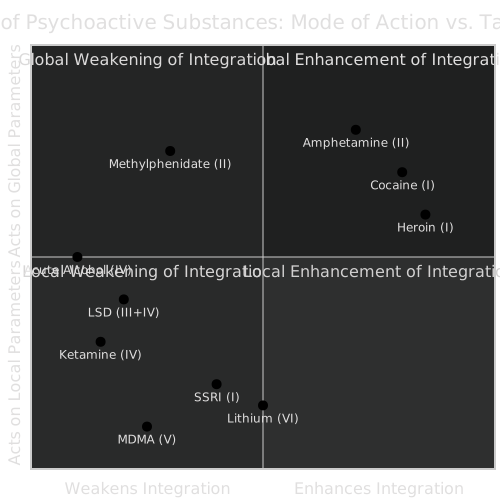
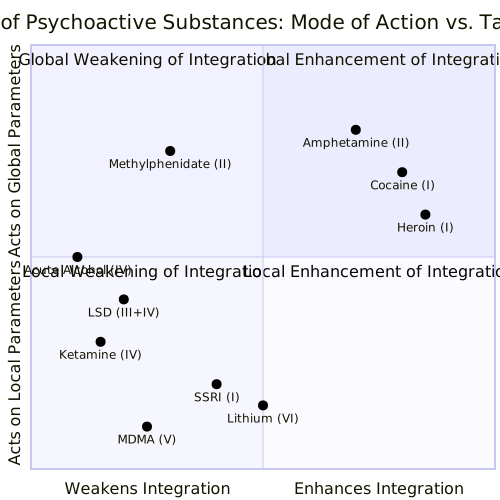
Diagram source
quadrantChart
title Classification of Psychoactive Substances: Mode of Action vs. Target of Action
x-axis "Weakens Integration" --> "Enhances Integration"
y-axis "Acts on Local Parameters" --> "Acts on Global Parameters"
quadrant-1 "Global Enhancement of Integration"
quadrant-2 "Global Weakening of Integration"
quadrant-3 "Local Weakening of Integration"
quadrant-4 "Local Enhancement of Integration"
"Cocaine (I)": [0.80, 0.70]
"Heroin (I)": [0.85, 0.60]
"Amphetamine (II)": [0.70, 0.80]
"Methylphenidate (II)": [0.30, 0.75]
"LSD (III+IV)": [0.20, 0.40]
"Ketamine (IV)": [0.15, 0.30]
"Acute Alcohol (IV)": [0.10, 0.50]
"SSRI (I)": [0.40, 0.20]
"Lithium (VI)": [0.50, 0.15]
"MDMA (V)": [0.25, 0.10]